WHAT IS INJUSTICE AND OPPRESSION?
Oppression is a form of injustice that occurs where one social group is subordinated while another is privileged, and oppression is maintained by a variety of different mechanisms including social norms, stereotyping and institutional rules. A key feature of oppression is that it is perpetuated by and affects social groups.
[Oppression] occurs when a particular social group is unjustly subordinated, and where that subordination is not necessarily deliberate but instead results from a complex network of social restrictions, ranging from laws and institutions to implicit biases and stereotypes. In such cases, there may be no deliberate attempt to subordinate the relevant group, but the group is nonetheless unjustly subordinated by this network of social constraints. (Taylor; 2016; Groups & Oppression 520-536).
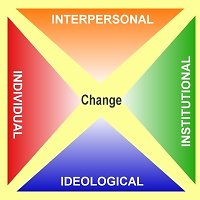
THE SOCIAL LEVELS OF OPPRESSION
IDEOLOGICAL OPPRESSION
Any oppressive system has at its core the idea that one group (dominant group), is somehow better than another in some measure: More intelligent, harder working, stronger, more capable, more noble, more deserving, more advanced, chosen, normal or superior, therefore has the right to control other groups. The dominant group holds this idea about itself, and of course, the opposite qualities are attributed to the other group/s.
INSTITUTIONAL OR STRUCTURAL OPPRESSION
Belief that dominant groups have the right to control others becomes embedded in the institutions and structures of the society- the laws, the legal system & police practices, the education system & schools, job hiring policies, housing, media dialogue and images and political power. Institutional/structural oppression is reinforced when policies and practices maintain inequalities between privileged and less privileged groups. Social institutions/structures, replicate the ideological beliefs & make injustice normal, every day and expected.
INTERPERSONAL OPPRESSION
Gives permission & reinforcement for individual members of dominant social groups (eg. men, white, straight, affluent, able-bodied) to personally disrespect, mistreat, harass and exhibit microaggressions towards members of oppressed groups: the essence of hate based thinking or behaviour. For example interpersonal abuses from one person to another due to racism, sexism, homophobia, ageism, Islamophobia, classism, etc. This is the level that most people identify racism, sexism, homophobia etc. by reducing individual acts of bias or hatred, as identifying and demonstrating whether person X is 'a racist', or 'a sexist'. In reality acts of interpersonal oppression express the institutional/structural and ideological frameworks which underpin these interpersonal acts and processes.
The oppressed group does not have the social power to enforce its prejudices unlike the dominant group. To stress again, interpersonal oppression is built on the ideological & institutional/structural oppressions which legitimate and normalise these interpersonal abuses. Because interpersonal oppression arises from ideological and institutional/structural oppression, it is inaccurate to talk of say, 'reverse racism': because racism is based on ideology and institutional/structural practices supporting white supremacy. In the example given of racism, a black person may have and express prejudice to a white person but the black person lives within the global ideology of white supremacy. In a world promoting say, 'heavily black melanised supremacy', for example, the social representations, expectations and entitlement to social power with respect to skin colour, would turn on its head what we view as normal or expected in the world we live in today.
It is important to recognise that we have to step-out of thinking within the 'black' 'white' binary and reframe ideological and therefore social power, as residing with the normalised institutional/structural laws, policies and practices created to support the ruling ideology. So in my alternative world for example of:
''High black melanised supremacy' over 'low black melanised populations'. If we view high levels of dark melanin skin pigmentation as supremely dominant and desirable in society, then it would be European people avocating for their human rights from the heavily melanised countries such as those in Africa, in charge of them. It is interesting to think of the narratives that might legitimate 'dark melanin supremacy' in this alternative ideological world view.
PSYCHOTHERAPY, COUNSELLING, PSYCHOLOGY & PSYCHIATRY CLINICAL TRAINING & PRACTICE AT BEST ONLY CONSIDERS THE INTERPERSONAL AND INTERNAL LEVELS OF OPPRESSION; ALTHOUGH NOT NORMALLY DESCRIBED OR UNDERSTOOD IN THIS WAY. PSYCHOTHERAPY AND COUNSELLING PROFESSIONS DO NOT LOCATE INTERPERSONAL AND INTERNALISED OPPRESSION PHENOMENA WITHIN BROADER INSTITUTIONAL/STRUCTURAL AND IDEOLOGICAL SYSTEMS OF INJUSTICE. THIS IS WHY PARTICULARLY WITH A FOCUS ON COUNSELLING AND PSYCHOTHERAPY LITERATURE AND ACADEMIC RESEARCH, CRITICAL THEORETICAL APPROACHES EXPLORING THESE DYNAMICS HAVE NOT EMERGED. THIS RESULTS IN AN INDIVIDUALISTIC AND DEPOLITICISED APPROACH IN MY PROFESSION WHICH CAN ONLY BE DESCRIBED AS HARMFUL WITHIN TRAINING, CLINICAL PRACTICE AND RESEARCH. THIS FAILURE IS NOT NEW AND HAS BEEN CONSISTENTLY IDENTIFIED AS PROBLEMATIC WITHIN THE COUNSELLING AND PSYCHOTHERAPY. PROFESSION FOR DECADES.
INTERNALISED/INDIVIDUAL OPPRESSION
Internalised oppression can be either internalised privilege and entitlement. For example a male believing he has the right to dominate women. Most people in the dominant group are not conscious of their internalised privilege, they have internalised societies belief that they operate within on a daily basis. In contrast to internalised privilege is internalised criticism, judgement and hatred encountered by those groups judged by the dominant group as inferior. For example women believing they must be slim, or a Chinese person wanting double eyelid surgery, or a black person using skin lightening cream: to look and feel closer to the social ideal. Those members in less ideologically privileged groups are taught by society that they are inherently defective or flawed. Believing the ideological truths underlying self privilege or self hate can create ideologically based mental illness which informs and harms self image within populations .
Working at the ideological through to the individual internalised level of oppression as appropriate for the presenting issues offers a more holistic therapeutic alliance and relationship.
OLUKEMI AMALA'S THEORETICAL ALIGNMENT WITH MODERN PSYCHOANALYSIS
Olukemi Amala’s ‘panopticality‘ meets Paul Wachtel‘s disavowed self.’
The linking of Olukemi Amala’s theory of “panopticality” and Paul Wachtel’s integrative psychoanalysis on the “disavowed self” represents a powerful synthesis of political-structural awareness and clinical internal processing. Together, they explain how social hierarchies force individuals into psychological self-surveillance, causing them to split off and reject vital aspects of their identity to remain safe within oppressive systems.
How these two concepts meet and interact dynamically:
Conceptual Frameworks
Olukemi Amala’s Panopticality:-Drawing from Michel Foucault’s panopticism;
Defines panopticality as "Developing the capacity to see oneself positioned within social hierarchies of power."
Such as within gender, gender-identity, ability, sexuality, class, race and age. For example, what is your positionality with respect to race? What is the social language of those like you racially? What about if you lived within the opposite social location with respect to race? How might that affect how others see you. How would this impact on your self worth or how you see the worth of other people like you? How does positionality affect how you see yourself and your skin colour? What about your positionality on gender? How does being a black man differ socially and economically from being a white man. What about a queer black man. What about a black woman verses a white woman? What about a white disabled transwoman vs a cisgender white disabled woman? Positionality and Intersectionality affects mental wellbeing within social oppression.
Living within minoritised, marginalised and pathologised social positions and structures; (eg. say, black living within the prevailing global ideology of white supremacy), functions as a method of white supremacy mental conditioning and reinforcement. Including constant blame, judgement, criticism and state-surveillance. Leading to internalised psychological self-surveillance. Leading to the disavowed self and psychological harm,. It forces a person to look to their “socially conditioned self”, to understand how their socially conditioned self came to life and maintained existence under social rules of constraints and entitlements. We need to navigate internal, interpersonal and other levels of systemic oppression that are constantly infiltrating our minds and our hearts.
Paul Wachtel’s disavowed or disallowed self
Paul Wachtel notes that the “disavowed self” (or disallowed self) consists of thoughts, feelings, and desires side-tracked during early development. Because expressing these parts caused anxiety or threatened relational attachment, they are pushed aside. Crucially, Wachtel emphasises that they are not entirely erased, but rather excluded from the active sense of self.
When panopticality meets the disavowed self, the clinical lens broadens from private childhood attachments to systemic realities:
The Cause of Disavowal: Wachtel focuses on how early caregiver attachment shapes what is disallowed. Amala expands this by showing that social structures (race, class, gender hierarchies) act as an overarching “macro-parent.” The “panoptic glare” of society demands specific conformities.
The Mechanism of Pushing Away: Under the internal monitoring, an individual judges themselves against social hierarchies. If a natural emotion (like anger, vulnerability, or a boundary) violates their assigned place in that hierarchy, it becomes highly dangerous to express. The individual then disavows that emotion to protect themselves from systemic or relational fallout and harm.
Interpersonal Vicious Cycles: Wachtel is famous for his cyclical psychodynamics—how internal disavowal causes actions that trigger negative external responses, reinforcing the original fear. Amala adds that these cycles are deeply entrenched by institutional and systemic oppression. For instance, a marginalised person disavowing rightful anger due to institutional surveillance might resort to over-compliance. This submission can then be exploited by the system, reinforcing the internal rule that anger is unsafe.
Implications for Therapeutic Healing
When a therapist brings both theories into the room, the goal of treatment evolves:
From Internal Fault to Systemic Awareness: Instead of framing a client’s disavowed parts purely as individual pathology or defense mechanisms, the therapist helps the client recognise that self-surveillance is a logical survival strategy against oppressive hierarchies.
Making Room for the Disallowed: Wachtel outlines clinical strategies to “make room” for these hidden resources in the present moment. Amala’s approach ensures that this reclaimation explicitly addresses how intersectionality and positionality shape what is allowed to be spoken.
Moving from unprocessed to processed. From reactive Surveillance to Psychological Agency: It is vital for the therapist to acknowledge the importance of the coping mechanism of self-surveillance in a world structured on power hierarchies. Therapy shifts the client from an automated state of self-censorship into active, critical awareness -panopticality – which allows for the development of and reclaiming their authentic self skillfully, and safely within social power relationships such as black white, male female, ablebodied disabled. To achieve this clinical dynamic in the therapy room, the therapist must consciously bring structural power into therapeutic discourse. How does the cli.ent’s social positions and the therapist differ?
Psychological work required to live healthy from either social position. Panopticality . leading to becoming socially conscious. The different psychological work required from each position. When working with a black female client (oppressed in society by race and gender).
By recognising why society forces people to hide certain parts of themselves, individuals can safely begin to reintegrate their disavowed power, anger, or vulnerability. Ultimately for a black person to gain mastery under white supremacy, this is vital for internal and interpersonal psycholological health and inner stability. Panopticality interrupts the socially conditioned internalisation of low worth, or inferiority. It is important for the white therapist to understand that: White children are socialised to see themselves as living inside the desirable white group, therefore there is no psychological conflict for a white child’s sense of racial comfort, entitlement and visibility – unlike for black children. This is the same dynamic that girls and women face within patriarchal power. Or a disabled person faces within ableism for example. So if we focus again on racial domination:
A white child’s development is normal and desirable under the ideology of white supremacy = psychological comfort (white child) verses psychological distress (black child). This is an example of an oppression based mental adjustment, which can develop into oppression based psychiatric illnesses.
When Dr. Paul Wachtel’s "disavowed self" intersects with Olukemi Amala’s concept of "panopticality", it creates a powerful framework for understanding how societal oppression is internalised into psychological distress.
Again, for clarity because this is complex:
Amala defines panopticality as developing the capacity to see oneself clearly within social hierarchies and understanding how our beliefs are socially conditioned. When this concept meets Wachtel's work, it expands the source of our inner distress from just the immediate family to the larger carceral, racial, and patriarchal, ableist, straight etc structures of society.
1. The Panopticon as the Original Disavower
In Wachtel's clinical framework, an individual disavows (pushes away) parts of themselves to stay safe and attached to their caregivers. Amala elevates this concept by showing that the social hierarchy itself acts as a controlling caregiver offering emotional comfort selectively.
Under a white supremacist, patriarchal, or colonial system, people of marginalised racial and gender identities are placed under a social "panopticon" (constant surveillance and judgment). To survive and remain safe within this oppressive structure, individuals are forced to disavow natural parts of their identity—such as their rage, their ancestral spiritual practices, or their authentic desires—because the dominant culture pathologises them.
2. Internalised Oppression vs. The Disavowed Self
Where Wachtel notes that disavowed traits seep through as clinical anxiety or relationship loops, Amala clarifies that these are actually "oppression-based mental health adjustments".
• The Intersection: What a traditional psychologist might diagnose as a purely internal personality defect or anxiety disorder is often the "disavowed self" desperately reacting to the trauma of systemic erasure.
• For example, in Under an Emerald Sky, the protagonist's ancestral spiritual sight is disavowed by her community and institutionalised by the state because it does not fit the Western style of the normal rational model of reality. How might the Amala-Wachtel theoretical union affect the clinical understanding, and treatment plan of the.other main character in Under an Emerald Sky, Mary Johnson, also a psychiatric patient with Yewande within Felan Ward, a site of state surveillance and social conformity/control.
3. The Path to Healing: Radical Self-Surveillance
Both thinkers Wachtel & Amala, look to integration for the cure, but their methods expand upon one another:
• Wachtel's View: Healing requires creating a safe therapeutic space so the hesitant, hidden parts of the self feel secure enough to step back into conscious awareness.
• Amala's Addition: True safety cannot be achieved in a vacuum. Healing requires a client to use panopticality as a tool for liberating self-surveillance. The individual must look outward at the power structures, realise why they were conditioned to reject parts of themselves, and use that socio-political awareness to actively reclaim their disavowed identity.
Ultimately, Wachtel provides the clinical anatomy of how we split ourselves to survive, while Amala provides the political map of who forced the knife into our hands in the first place.
Ref:
Attachment, Anxiety, and the Disavowed Self: Insights from Dr. Paul Wachtel, 2023.
PERSON-CENTERED METHOD WITH A ‘BLACK MALE CLIENT’ VERSES AMALA’S PANOPTICAL PSYCHOTHERAPY
The comparison between Carl Rogers and Olukemi Amala regarding therapy sessions with a Black male client highlights a fundamental evolution in psychotherapy: the shift from classical, non-directive, race-neutral humanism to contemporary, intersectional, and structurally aware practice.
The primary point of contrast lies in how each therapist conceptualises the client's internal distress. Rogers approaches the client through a universal human lens of individual emotional expression, while Amala actively contextualises the client's trauma within systemic oppression, institutional racism, and socio-political power structures.
Carl Rogers: The 1977 Demonstration Session
In his famous 1977 demonstration film, Carl Rogers Counsels an Individual (divided into Right to be Desperate and On Anger and Hurt), Rogers conducts a person-centred session with a young Black man who is in remission from leukaemia.
• The Core Approach: Rogers relies on his foundational "core conditions"— empathy, unconditional positive regard (UPR), and congruence. He strives to create a safe, warm climate so the client can safely explore buried feelings of anger, illness, and a failed interracial marriage.
The Structural Blindspot: Modern critiques, compiled in texts like Carl Rogers Counsels a Black Client, note that Rogers initially operates under a "race-blind" framework. The client explicitly states that the culture has inflicted a "cancer of his mind" worse than his leukaemia. However, instead of exploring the specific trauma of systemic racism, Rogers tracks and reflects only the raw, universal emotions of anger and hurt.
• The Missed Opportunity: By keeping the focus purely internal, Rogers misses crucial cultural undercurrents—such as the unique societal pressures surrounding vulnerability, anger, and safety for an African American man in the 1970s.
(Note: Modern scholars note that Rogers later recognised this limitation, adapting his approach in a 1984 session with an African American client to directly validate the complexities but nesessary task of discussing systemic racism in the session for a white therapist).
Olukemi Amala: The panoptical approach
Olukemi Amala’s approach functions as a direct response to the limitations of classical western therapy models when working with marginalised issues, individuals, cultures/communities.
• The Core Approach: Amala integrates traditional psychoanalytic and psychodynamic and cognitive tools with an explicit evaluation of social systems of privilege and disadvantage. For a Black male client, Amala maps out how external oppression intersects with personal psychology.
• Deconstructing Society's "Boxes": Amala explicitly rejects looking at oppressed groups through an inherently pathological lens. She points out that society continually scrutinises marginalised individuals, forcing them to work harder for social validation. In a session, she will directly address how historical narratives and macro-level systems inject messages of worthlessness, guilt, or shame into the client’s subconscious.
• Active De-colonial Framework: Unlike Rogers' strictly non-directive style, Amala co-navigates the space by helping the client deliberately look at how social structures impact his personality. She deconstructs microaggressions and biases rather than hoping like Rogers, that they will naturally dissolve through generic warmth.
Direct Comparison: Methodological Differences
Clinical Dimension Carl Rogers' Framework vs. Olukemi Amala's Framework
Therapist Stance Universally humanistic, neutral, and strictly non-directive.vs. Positional/Intersectional, structurally aware, and integrative.
View of the Client's Pain Internalised, universal conflict regarding personal experiences vs. The intertwined result of external oppression, family systems, and subconscious internalised shame.
Handling of Race/Systemic Trauma Viewed as an external detail; the priority is reflecting the emotional core (anger, despair) vs. Viewed as an essential structural truth that dictates how the client experiences reality.
The Goal of Therapy Achieving individual self-actualisation and congruence vs. Building psychological stability by recognising and negotiating life under oppressive forces.
.
The Amala method is socially truthful:
Choosing to name and validate systemic realities is what many contemporary practitioners like Olukemi Amala, call being “socially truthful" or structurally honest.
While Carl Rogers’ approach was revolutionary for its time because it gave clients total permission to feel, its major flaw when working with marginalised groups is individualising systemic pain. When a therapist treats structural oppression (like racism, classism, or homophobia) only as an internal emotional conflict, it can inadvertently feel like gaslighting. It puts the burden entirely on the client to "fix" their internal world, while ignoring the fact that the external world is genuinely hostile.
By contrast, the intersectional framework used by practitioners like Olukemi Amala acknowledges that a client’s distress is often a completely logical, healthy reaction to an unhealthy, oppressive system.
Here is why this social truthfulness changes the therapeutic dynamic for a Black client:
• It removes false neutrality: Pretending a therapy room is a vacuum free from societal power dynamics is a fiction. Acknowledging race, gender, and power brings reality into the room.
• It depathologises the client: Instead of the client feeling like "Something is wrong with me because I am angry/paranoid," the framework clarifies, "I am experiencing anger because I am navigating an unjust system."
• It shifts the healing goal: Healing stops being just about "accepting oneself" (self-actualisation) and becomes about survival, resistance, and navigating structures without letting them destroy your sense of self-worth.
Rogers provided the baseline for emotional safety, but Amala’s approach provides the structural vocabulary needed to make that safety meaningful in the real world.
Using a socially truthful (structurally aware and intersectional) framework in psychotherapy like Amala’s approach, requires moving away from the traditional, "race-blind" Western models of the past.Teaching this method involves training students to see the client not just as an isolated psyche, but as a person embedded within historic, political, and socio-economic systems.
How educators integrate this socially truthful method into psychotherapy training:
1. Deconstructing the "Neutral Therapist" Myth
Traditional training often teaches students to be a tabula rasa (blank slate) or a completely neutral, objective mirror (as Rogers and most psychotherapy and clinical counselling modalities often attempt).
• The Social Truth: In reality, the therapist’s race, gender, class, and accent enter the room before a single word is spoken.
• How it's taught: Students participate in reflexivity exercises. They must map out their own social locations (privileges and marginalisations) and explicitly discuss how their identity might impact for example a Black male or female client diffrrently. Development of Panoptical Awareness. Instructors teach students that staying "silent" or "neutral" on issues like race is actually a political choice that usually protects the therapist if from the dominant white group..
2. Moving from "Cultural Competence" to "Cultural Humility."
Older training models focused on "cultural competence"—essentially memorising lists of traits about specific ethnic groups (which often led to stereotyping).
• The Social Truth: No one can be fully "competent" in another person's culture, and cultures are not monoliths.
• How it's taught: Programs teach cultural humility and structural literacy. Students are trained to understand the actual mechanisms of oppression (e.g., how the school-to-prison or / and mad pipelines structurally operate, medical racism, or microaggressions affect a Black man or woman’s nervous system). The focus shifts from "What are Black people like?" to "How does systemic racism physically and mentally impact this specific individual?"
3. Rewriting Clinical Case Formulations
In standard training, a case formulation (the summary of why a client is distressed) usually focuses heavily on childhood, attachment styles, or cognitive distortions. The Social Truth: If a Black client is hypervigilant in public spaces, labelling it purely as "clinical paranoia" or an "anxious attachment style" ignores realiy. Trainees are taught to use intersectional case formulations. They learn to draw genograms and diagnostic maps that include external stressors. A student's case notes must explicitly differentiate between internal psychological pathology and a normal, protective response to systemic hostility.
4. Training in Radical Transparency and Naming
Students are traditionally taught to wait for the client to bring up difficult topics. In a socially truthful framework, the therapist takes proactive responsibility.
• The Social Truth: A marginalised client may not feel safe bringing up race or power dynamics, fearing the therapist will misunderstand, get defensive, or pathologise them.
• How it's taught: Instructors teach students how to broach these topics early on. Students practice explicit role-play scripts to open the door for social truth.
Social Truthfullness in case studies & role-play exercises
To see how this changes classroom education, consider how an instructor would guide a student during a practice session with a Black male client who says: "I feel like everyone at my new corporate job is constantly watching me, waiting for me to slip up."
• The Traditional (Rogers-style) Guidance: The instructor tells the student to focus on the core emotion: "Reflect his underlying anxiety. Say something like: 'It sounds like you feel incredibly pressured and unsafe in that environment.'" (This validates the feeling, but leaves the cause entirely vague and internal).
• The Socially Truthful Guidance: The instructor stops the student and says: "Look at the context. He is likely one of the few Black men in that corporate space. His anxiety might be a completely accurate assessment of hyper-scrutiny and microaggressions." The student is taught to respond: "It makes total sense you feel that way. Navigating predominantly white corporate spaces often means facing intense, unfair scrutiny. Are you noticing specific things people are doing that trigger that feeling?"
This shift teaches the student to validate the reality of the environment, not just the insecurity of the client. The power of developing, maintaining and reanalysing individual panopticism, reduces the potential of therapeutic harm to the client.
Olukemi Amala’s concept of panopticality also directly critiques the limitations of standard Cognitive Behavioral Therapy (CBT) when treating Black and minoritised clients. While standard, manualised CBT focuses on restructuring individual thoughts, Amala’s panopticality frames a Black client’s psychological distress as a rational, defensive adaptation to living within systemic, white supremacist social hierarchies.The core conflict between Amala’s integrative approach and standard CBT for a Black client revolves around the following distinct dimensions:
Cognitive Behavioural Therapy is also socially neutral and does not recognise the role of social power on mental health
1. The Locus of the “Problem” Standard CBT: Views distress as the result of localised, individual cognitive distortions or faulty thinking patterns (e.g., catastrophising or paranoia). Amala’s Panopticality: Redefines these “distortions” as justified vigilance. For a Black client, anticipating bias or surveillance is a realistic appraisal of safety, not a cognitive error. Amala asserts that an individual’s identity and beliefs are inextricably intertwined with the larger social, as well as familial, and individual biochemical systems they inhabit.
2. Internalised Self-Surveillance vs. Behavioural Goals Standard CBT: Encourages self-monitoring to track thoughts and behaviours against a normative standard of “healthy functioning."
”Amala’s Panopticality, explained once again: Uses the metaphor of the panopticon—a system where prisoners modify their behaviour because they assume they are always being watched—to address how Black and other socially minoritised clients experience psychological self-surveillance. Black clients are often conditioned by societal hierarchies to constantly evaluate their own behaviour through the dominant white cultural lens. Therapy must expose this oppressive socio-political dynamic rather than purely coaching behavioural adjustments.
3. Decontextualised vs. Systemic Formulation Standard CBT: Often uses disorder-specific models that omit or bypass the predisposing, precipitating, or maintaining factors of racism, and other structural oppressions, and discriminations.
Amala’s Panopticality: Asserts that true healing requires developing a capacity to see oneself clearly within social hierarchies. Amala integrates positionality theory and other social theories directly into therapy. This helps the client untangle internalised oppression from their true self, validating their reality instead of pathologising it.
Summary of Differences in Standard CBT verses Amala’s Panopticality Framework
Primary Goal:
Modify internal thoughts to change feelings and behaviour.
Interrogate conditioned social patterns and habits.
Could vigilance and hypervigilance offer a new way of interpreting external systemic threats and surveillance?
Therapeutic Lens CBT: Individualistic and intrapsychic.
Amala does not discard cognitive theories; her integrative practice utilises them alongside others which include positionality/Intersectionality theories, psycho analytic and psycho dynamic concepts, narrative therapy, and ancestral generational healing .
WHY THE AMALA-WACHTEL SYSTEM IS HARD FOR TRADITIONAL PSYCHOLOGY TO IGNORE
By using the clinical mechanics of psychoanalysis to explain the psychological toll of social oppression, it speaks the language of traditional psychology while fundamentally challenging its narrow focus.
Here is why traditionalists cannot easily deny the fit between Wachtel’s disavowal and Amala’s panopticality:
1. It Uses Approved Psychological Mechanics
Traditional psychoanalysis is deeply concerned with the internal mechanisms of survival—how the ego splits, defends itself, and represses parts of the self to maintain safety.
• Wachtel’s framework establishes that the brain will reject its own authentic pieces if a dominant authority makes expressing them unsafe.
• Traditionalists cannot deny this mechanism because it is the bedrock of attachment theory.
• When Amala maps this mechanism onto social oppression, she simply expands the definition of "the authority." If a child splits their identity to survive a punitive parent, a marginalised person will absolutely split their identity to survive a punitive, racist, or patriarchal society. The psychological architecture is identical.
2. It Redefines "The Environment"
For over a century, traditional therapy has acknowledged that clinical symptoms are reactions to an invalidating environment. However, traditionalists usually limit "the environment" to the nuclear family (e.g., a cold mother or an abusive father).
• Bringing panopticality into the equation forces traditionalists to admit that the nuclear family does not exist in a vacuum.
• Parents pass down the trauma of the panopticon to their children. If a parent forces a child to disavow their ancestral roots, their anger, or their gender non-conformity, the parent is often just acting as the enforcement arm of a larger social hierarchy.
3. It Moves Past the "Blame Game"
Traditionalists often push back against social justice frameworks because they feel these frameworks externalise all problems, ignoring personal agency and internal conflict.
• This intersection satisfies both sides. It does not ignore the internal world; instead, it looks deeply at internal conflict (Wachtel's disavowed self) while providing a structural reason for why that conflict exists (Amala's panopticality).
• It changes the therapeutic question from a dismissive "Why are you broken?" to a highly precise "What did you have to sacrifice inside yourself to survive the world you live in?"
By using the strict, rigorous rules of psychological defense mechanisms to explain the invisible injuries of systemic oppression, this combined approach leaves traditionalists with very little room to argue. It proves that social oppression is not just an external, political issue—it is a deeply internal, clinical reality.
Modern Mental Health: Panopticality is a challenge to practitioners everywhere
If the primary ethical oath of a practitioner is to “first, do no harm,” then a therapist who has not explicitly mapped out their own position within societal power structures is almost guaranteed to commit unintentional, institutional harm. Without “panoptic awareness,” a clinician cannot distinguish between genuine clinical pathology and a client’s adaptive survival strategies against a hostile world. This standard transforms how we view professional qualification and clinical safety across three main fronts:
1. The Bar for Entry: A practitioner shouldn’t just be asked, “How do you handle countertransference?” They must be able to fluidly answer: “How does my specific racial, gendered, and institutional privilege alter the way I hear and diagnose this specific client’s pain?”
2. Preventing “Therapeutic Malpractice” via Pathologisation. When a therapist is fragile or unexamined, their clinical clipboard becomes an active weapon of societal surveillance. Unconscious Harm: A therapist who has not negotiated their own panopticality will naturally look at a character like Yewande from Under an Emerald Sky and instinctively diagnose her spiritual lineage as psychosis. The True Harm: This isn’t just a clinical disagreement; it is malpractice. It uses the authority of medicine to violently strip away a marginalised person’s cultural sanity, forcing them to disavow their true self just to receive help.
3. A New Blueprint for Clinical Training. Making “negotiating one’s own panopticality” a prerequisite for qualification would completely revolutionise higher education and training programs. Moving Beyond the Textbook: Training would shift away from the comfortable, intellectual safety of standard lectures. Tolerating the Discomfort: Trainees would be forced into experiential spaces where they must sit with their own professional fragility, unpack their defensive reactions to differences, and unlearn the myth of the “neutral, all-knowing expert.” Ultimately, this underscores why Amala’s crossover between literature and clinical training has put her on the academic map. She proves that to truly do no harm, a therapist must step out of the illusion of social isolation and actively dismantle the internalised prison guards within their own mind before they ever dare to try and heal someone else’s.
If therapy only helps a client "adjust" to an oppressive environment without acknowledging the positionality and intersectionality networks they live in, the therapy itself is just acting as another tool of social control.
''Olukemi Amala refuses to work with any client in social neutrality, as if human life exists in a socio-political vacuum."